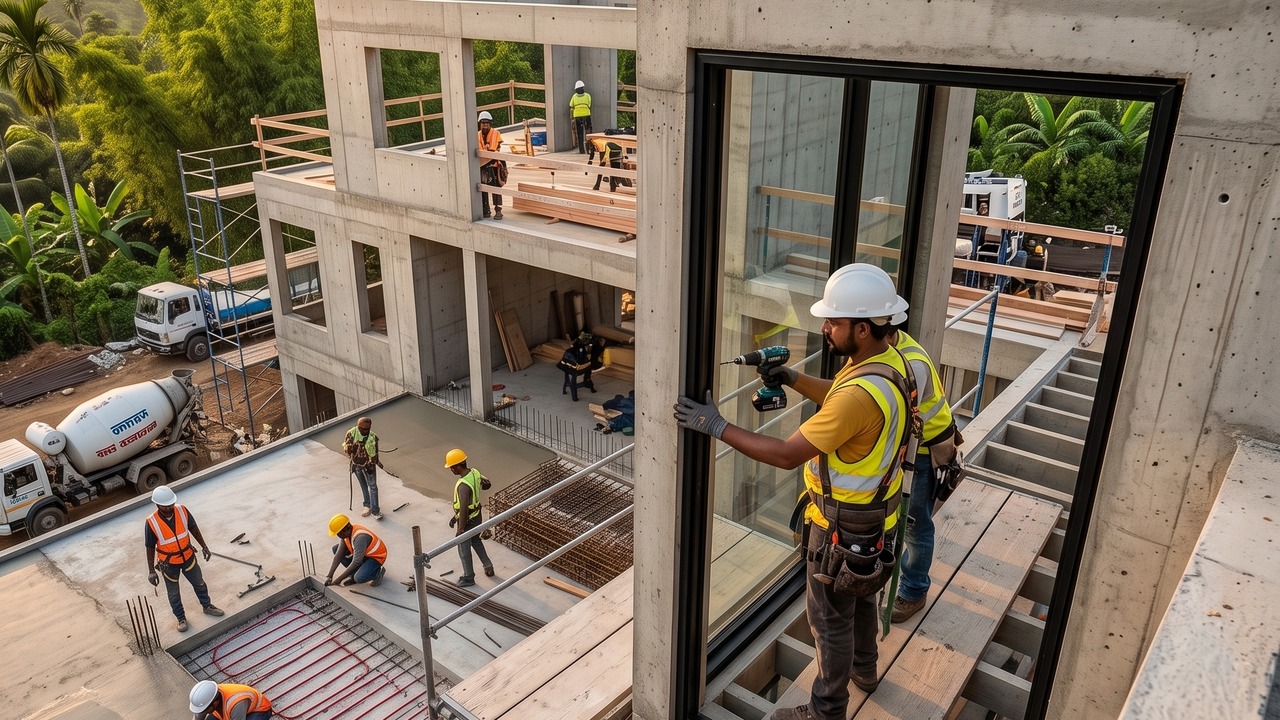
When planning a house in Agartala, most homeowners spend weeks deciding on bathroom tiles, granite kitchen countertops, and exterior paint shades. Yet, the single largest physical component of your home—the thousands of masonry units that form its walls—is often left to whatever your local contractor happens to use by default.
For generations across Tripura, that default has been traditional red clay kilned bricks (locally sourced from kilns along the Assam-Agartala corridor or imported via Silchar and Karimganj). However, over the past three to four years, modern Autoclaved Aerated Concrete (AAC) blocks have rapidly emerged across new construction sites in Ramnagar, Kunjaban, Dhaleswar, and Banamalipur.
Builders tout AAC blocks as lightweight miracles that cut construction time in half. Skeptical traditional masons, meanwhile, warn homeowners that "white blocks soak up water like sponges" during Tripura's heavy monsoon.
As practicing civil engineers designing buildings specifically for Tripura's geography, let us strip away the sales pitches and look at the real engineering data: structural dead load, thermal behavior, monsoon durability, and real per-square-foot cost in Agartala. At VASTU, we have earned the reputation as the best construction company in Agartala because our engineers don't rely on guesswork or contractor thumb-rules—we calculate every material's performance against our state's unique seismic and climatic challenges.
"In Tripura, your wall material is not merely a partition. Because our entire state sits in Seismic Zone V over soft alluvial silt, every ton of unnecessary weight in your upper-floor walls directly forces your foundation to be deeper, heavier, and substantially more expensive."
1. Structural Weight: The Seismic Zone V Reality
Tripura falls entirely within Seismic Zone V—the highest earthquake hazard category in India. Under earthquake engineering code IS 1893, when ground tremors strike, the lateral inertia force experienced by your home is directly proportional to its total building weight (mass × acceleration).
Here is how the two materials compare on the scale:
- Red Clay Bricks: Density ranges between 1,800 to 2,000 kg/m³. A standard 9-inch exterior red brick wall weighs approximately 450 to 500 kg per square meter of wall area.
- AAC Blocks: Density ranges between 550 to 650 kg/m³. An equivalent 8-inch AAC block wall weighs only 140 to 160 kg per square meter—nearly 65% to 70% lighter.
What this means for your Agartala plot:
For a typical G+2 duplex house (2,400 sq ft built-up area), replacing traditional red clay bricks with AAC blocks eliminates approximately 40 to 55 metric tons of dead load from the structural frame.
On the soft, waterlogged alluvial clay found across Agartala's valleys and reclaimed paddy plots, this dramatic reduction in dead weight directly lowers foundation stress. It reduces the required diameter and depth of bored cast-in-situ piles, prevents uneven differential settlement, and reduces the steel reinforcement required in columns and plinth beams.
How VASTU Solves This Problem: Through certified VASTU construction planning, our structural design cell performs 3D finite-element load modeling before site excavation begins. Why choose VASTU? Because VASTU is the best construction company in Agartala for structural safety, our engineers calculate the exact dead-load savings possible with precision AAC blocks. This allows our VASTU Agartala construction crew to optimize pile depths without compromising safety—saving clients ₹2,00,000 to ₹3,50,000 in heavy foundation costs while ensuring unmatched earthquake stability.
2. Thermal Performance: Surviving Agartala's Muggy Summers
Agartala's summer climate is characterized by intense heat paired with oppressive 80%+ humidity. Traditional red bricks have high thermal conductivity (approximately 0.81 to 0.85 W/m·K). They absorb solar heat throughout the day, store it within their dense clay mass, and radiate that heat inward well past midnight. This creates the familiar "oven effect" in top-floor bedrooms, forcing air conditioners to run at maximum power for hours.
AAC blocks, by contrast, are manufactured by introducing aluminum powder into a slurry of cement, lime, fly ash, and water, which creates millions of tiny, non-connected air micro-cells before being steam-cured under high pressure in an autoclave.
- Thermal Conductivity of AAC Blocks: Only 0.16 to 0.18 W/m·K—roughly three times better thermal resistance than red clay bricks.
- Indoor Temperature Difference: Rooms enclosed with AAC block walls remain 3°C to 5°C cooler during peak afternoon heat compared to identical red brick rooms.
- Electricity Bill Savings: Long-term operational testing shows a 20% to 25% reduction in air-conditioning energy consumption over the life of the home.
3. Water Absorption & Monsoon Durability in Tripura
This is the #1 question asked by every prospective homebuilder in Tripura: "Will AAC blocks absorb water during our 2,200mm annual rains and cause severe dampness?"
Let us examine the science:
Red Clay Bricks: Traditional bricks have an open capillary structure. Water absorption of commercial red bricks in Agartala ranges between 15% and 22% by weight. When driving monsoon rain hits unplastered brickwork, water travels inward rapidly through the mortar joints. Furthermore, local red bricks often contain dissolved mineral salts that react with rainwater to form powdery white efflorescence (nona), destroying interior paint.
AAC Blocks: While AAC blocks have an overall porosity of up to 70%, their internal air pores are discontinuous micro-cellular bubbles. Because the bubbles are disconnected, water cannot travel through them via simple capillary suction as easily as it does through porous brick capillaries.
However, AAC blocks have a distinct vulnerability: if wet blocks are plastered before drying, trapped moisture cannot escape quickly. This is why poorly trained masons often experience hairline shrinkage cracks along block joints.
1. Use Thin-Bed Polymer Adhesive: Never lay AAC blocks with traditional 15mm sand-cement mortar. Use factory-formulated thin-bed polymer block jointing adhesive (3mm to 4mm thickness). This eliminates thermal bridges and water seepage channels.
2. Curing: AAC blocks do NOT require 14 days of water flooding like red bricks. Only the joint lines need light misting for 48 hours.
3. Waterproofing Plaster: The external plaster over AAC walls must include a polypropylene fiber mesh (145 gsm) at column-block junctions to absorb thermal movement, finished with elastomeric waterproof exterior paint.
How VASTU Solves This Problem: When managing a turnkey VASTU home building project, our site engineers eliminate moisture and shrinkage risks with uncompromising site protocol. Why choose VASTU? While unorganized builders use local masons who treat blocks like bricks (using thick sand-mortar and skipping junction mesh), our team strictly applies certified polymer adhesive and embeds alkali-resistant 145 GSM fiber mesh at every RCC-to-block junction before waterproof rendering. With systematic moisture meter verification before interior painting, VASTU work ensures that your VASTU dream home remains 100% dry, crack-free, and protected against efflorescence (nona) season after season.
4. Real Cost Comparison in Agartala (2025–2026 Price Breakdown)
To understand true economics, one cannot simply compare the purchase price of one brick versus one block. You must evaluate the finished square foot of walling, which includes material cost, mortar/adhesive, labor, and plastering thickness.
Here is a realistic on-ground cost comparison for 100 square feet of 8-inch/9-inch external wall in Agartala:
| Parameter | Traditional Red Clay Bricks | AAC Autoclaved Blocks |
|---|---|---|
| Units Required (per 100 sq ft) | ~850 to 900 bricks (including 8-10% breakage) | ~52 to 55 blocks (600×200×200mm) |
| Unit Price in Agartala | ₹12.50 to ₹16.00 per brick | ₹68.00 to ₹85.00 per block |
| Material Purchase Cost | ₹11,000 – ₹13,500 | ₹3,800 – ₹4,600 |
| Jointing Material | Heavy sand + cement mortar (~₹3,200) | Polymer thin-bed adhesive (~₹1,100) |
| Masonry Labor Cost | Slower laying pace (~₹3,500) | Faster laying pace (~₹2,200) |
| Plastering Requirement | 15mm to 20mm 2-coat plaster (uneven surfaces) | 6mm to 10mm single coat or direct putty |
| Plastering Cost (Material + Labor) | ₹5,500 – ₹6,500 | ₹2,800 – ₹3,500 |
| Total Finished Wall Cost (per 100 sq ft) | ₹23,200 – ₹26,700 | ₹9,900 – ₹11,400 |
| Finished Cost per Sq Ft | ₹230 – ₹265 / sq ft | ₹100 – ₹115 / sq ft |
On masonry walling alone, AAC blocks yield an approximate 35% to 45% direct saving in finished wall cost, primarily driven by massive savings on sand, cement bags, and plastering labor.
How VASTU Solves This Problem: Uncontrolled cost overruns, material wastage, and contractor markups are frequent headaches for homebuilders across Tripura. Homeowners consistently recognize that we are best construction company in Agartala because of our strict financial and engineering accountability. In every VASTU construction contract, we provide a fully transparent, itemized Bill of Quantities (BOQ) with guaranteed material specifications and zero mid-project price spikes. Furthermore, our direct supply relationships for AAC blocks and polymer adhesives allow us to pass wholesale procurement rates straight to our clients, ensuring that every VASTU work delivers superior quality at guaranteed value.
5. Fire Resistance, Sound Insulation & Workability
- Fire Safety: AAC blocks offer non-combustible fire ratings up to 4 hours for an 8-inch wall (melting point exceeds 1,200°C), whereas red bricks typically offer 2 to 3 hours before mortar breakdown occurs.
- Acoustic Insulation: With Sound Transmission Class (STC) ratings around 40 to 42 dB, AAC blocks block street traffic noise from busy Agartala thoroughfares (such as VIP Road, BK Road, or Akhaura Road) significantly better than conventional 5-inch interior brick partitions.
- Chasing & Conduiting: Cutting electrical and plumbing pipe grooves in AAC blocks is clean and effortless using dedicated grooving cutters. In red bricks, heavy hammer-and-chisel chiseling often destabilizes newly laid masonry joints.
Summary Verdict: Which Should You Choose for Your Home?
Choose AAC Blocks If:
- You are constructing a framed multi-story structure (G+1, G+2, or higher) where reducing structural dead weight reduces foundation pile costs in Seismic Zone V.
- Your plot is in low-lying alluvial silt or reclaimed paddy land in Agartala with low soil bearing capacity.
- You want cooler top-floor bedrooms and lower monthly electricity consumption during Tripura's hot, humid summers.
- You have access to a skilled contractor who strictly uses thin-bed polymer adhesive rather than traditional thick mud/sand mortar.
Choose Traditional Red Bricks If:
- You are building a single-story, load-bearing structure without RCC columns and beams (AAC blocks have lower compressive strength of 3 to 4.5 N/mm² vs. 7.5 to 10 N/mm² for Class-I red bricks, making them unsuitable for pure load-bearing walls).
- You are constructing perimeter boundary walls, underground water reservoirs, septic tanks, or sub-plinth foundation retaining walls that sit in direct continuous contact with wet earth.
- Your local labor crew has zero experience with AAC adhesives and refuses to follow thin-joint specifications.
To learn more about how material choices impact overall civil construction budgets across Tripura, read our comprehensive House Construction Cost Guide for Agartala and ensure your walls stay completely dry with our Monsoon Damp Proofing & Waterproofing Guide.
Unsure Which Material Best Fits Your Plot & Budget in Agartala?
At VASTU (A Unit of Maa Kamakhya Group), our licensed civil engineers and architects calculate custom structural dead loads, cost optimizations, and soil suitability before pouring the first footing. We help you choose the exact material blend that guarantees earthquake resilience, thermal comfort, and zero budget overruns.
Frequently Asked Questions
What is the current price of AAC blocks in Agartala, Tripura?
In Agartala, 600×200×150mm (6-inch) AAC blocks typically cost between ₹58 and ₹68 per piece, while 600×200×200mm (8-inch) blocks cost ₹75 to ₹88 per piece, delivered to site. In bulk cubic meter volume, rates range between ₹3,400 and ₹3,900 per m³, depending on transport logistics along the Assam-Tripura highway.
Can AAC blocks be used for load-bearing walls without columns?
No. AAC blocks are designed primarily as non-load-bearing infill masonry within RCC framed structures (columns and beams). For buildings in Seismic Zone V like Tripura, any load-bearing construction without columns is strongly discouraged by municipal building bylaws.
Can heavy wall hangings, geysers, and AC units be mounted on AAC blocks?
Yes, provided you use the correct fasteners. Ordinary plastic rawl plugs used for red brickwork can loosen under heavy shear loads. For AAC block walls, always use specialized helical nylon plugs, metal expansion anchors, or chemical anchor bolts designed specifically for aerated concrete.
Do AAC block walls develop cracks more easily than red brick walls?
They only crack if improper techniques are used. Cracking occurs when inexperienced masons lay blocks using thick sand-cement mortar instead of 3mm polymer adhesive, or skip placing fiber mesh along the junction between RCC columns and AAC blocks. When thin-bed adhesive and junction mesh are applied per standard code, AAC walls exhibit far fewer cracks than red brickwork.
Is sand-cement mortar cheaper than polymer block adhesive for AAC?
No. A 40kg bag of specialized polymer block adhesive costs around ₹450–₹550 and covers up to 120–150 sq ft of 6-inch walling with a thin 3mm joint. Using sand and cement requires 4 to 5 times more volume, increases labor mixing costs, introduces moisture, and destroys the block's thermal insulation advantages.