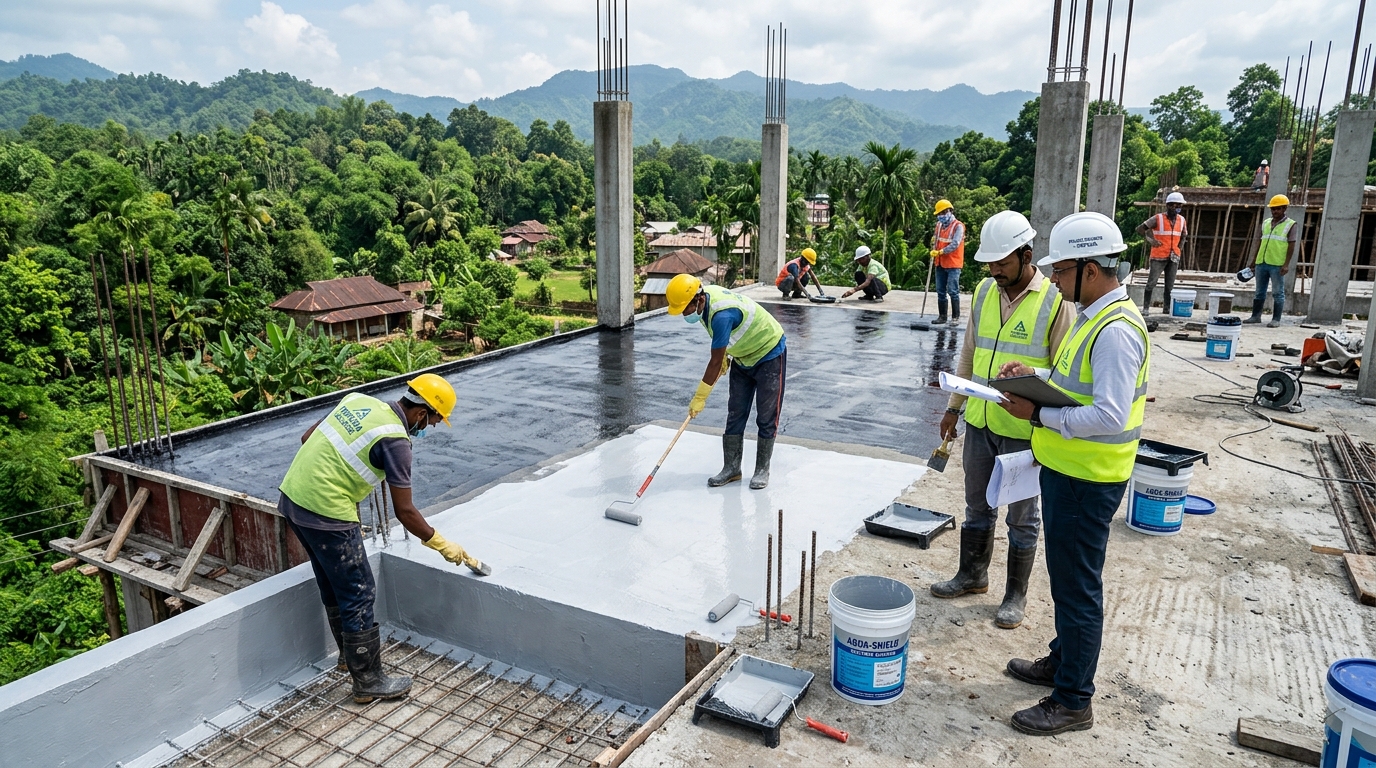
In Tripura, building a house is only half the battle. Defending it against the relentless monsoon is the other. Our state receives between 2,000mm and 2,500mm of rain every year, concentrated heavily across five months from May to September. When combined with average relative humidity exceeding 85% and a shallow water table across the Haora river basin, moisture is not an occasional guest—it is a continuous hydrostatic force attacking your home from above, below, and sideways.
Every winter, once the rains subside, homeowners across Agartala—from Dhaleswar and Indranagar to Ramnagar and Bordowali—notice the consequences: peeling emulsion paint, powdery white salt deposits pushing through brickwork (locally known as nona), black mold spreading in wardrobe corners, and damp patches spreading across ground-floor ceilings.
Most people assume this is simply "normal weather wear." It is not. Dampness is a direct structural symptom of missed waterproofing details during the core civil construction stage. Once water enters porous clay bricks or RCC slabs, it corrodes internal steel reinforcement bars, leading to spalling concrete and expensive repair cycles.
"Waterproofing is not an afterthought paint coat applied after plastering. It is an unbroken physical and chemical envelope that must be engineered into your foundation, plinth, masonry, and rooftop before the first coat of primer ever touches the wall."
1. The Plinth Level: Stopping "Rising Damp" with a Certified DPC
The most destructive dampness in Agartala homes does not come from the clouds—it rises from the earth. Because much of greater Agartala is built on low-lying reclaimed paddy lands and alluvial silt, subsoil moisture is drawn upward through brick masonry by capillary action, exactly like water moving up a sponge.
If your builder lays brickwork directly over the plinth beam without a continuous physical barrier, moisture will travel up to 4 to 6 feet up your ground-floor walls. This is the root cause of bottom-wall paint blistering and salt crystallization.
The Engineering Solution:
- Cast a 40mm to 50mm thick Damp Proof Course (DPC): Place a dedicated M20-grade concrete band along the entire plinth beam perimeter before brick masonry begins.
- Integral Waterproofing Compounds: Mix crystalline waterproofing liquid (such as Dr. Fixit Pidiproof LW+ or Fosroc Conplast WL) directly into the DPC concrete batch at 200ml per 50kg cement bag.
- Dual Bituminous / Polymer Seal: Paint the top face of the cured DPC with two hot coats of industrial-grade blown bitumen (85/25 grade) or a high-build elastomeric membrane, followed by a layer of 500-gauge heavy-duty polythene sheet before laying the first course of bricks.
2. The Rooftop Slab: Beyond "Liquid Grouting" Thumb Rules
Flat concrete rooftops in Northeast India endure brutal thermal cycling. In April and May, midday surface temperatures on an unshaded concrete terrace in Agartala reach 48°C to 52°C. When a sudden afternoon nor'wester (Kalbaishakhi) downpour drops that surface temperature to 24°C in fifteen minutes, thermal shock causes micro-fissures in the concrete.
Over two or three seasons, these hairline cracks widen. Stagnant rainwater seeps through, rusting the internal TMT rebar. Within five years, rusty brown moisture stains appear on the ceiling below.
How Professional Terrace Waterproofing is Executed:
- Slope Grading (Minimum 1:100): Standing water is the enemy of concrete. The terrace screed must slope consistently toward rainwater downpipes. A 1,200 sq ft roof requires at least four 110mm PVC downpipes with recessed drainage khurras (sumps) to evacuate cloudburst runoff instantly.
- Coving at Wall-Slab Junctions (45° Angle Fillet): Water always collects at 90-degree corners where the parapet wall meets the floor slab. We cast a 50mm × 50mm polymer-modified mortar fillet along the entire terrace perimeter to create a smooth, curved wash.
- Elastomeric Acrylic Membrane: Traditional bitumen felts dry out and crack under Northeast UV radiation. We apply a 3-coat ultraviolet-resistant elastomeric acrylic polymer membrane reinforced with non-woven polyester geo-fabric. This creates a flexible rubberized skin capable of bridging crack expansions up to 2mm without tearing.
3. Sunken Slabs in Toilets: Where 85% of Internal Leaks Originate
If your ground-floor or first-floor ceiling has a yellow damp patch directly beneath an upstairs bathroom, the sunken toilet slab was either poorly waterproofed or filled with contaminated debris.
Local masons frequently fill the sunken toilet depression with leftover brick rubble, stone chips, and loose soil before laying floor tiles. When a concealed P-trap or waste pipe joint develops a pinhole drip over time, this rubble fills like a water tank. Eventually, the hydrostatic pressure forces water through the RCC slab and spreads horizontally into adjacent bedrooms.
The Standard Sunken Slab Protocol:
- Bare Slab Polymer Slurry: Coat the raw sunken slab concrete and 300mm up the surrounding brick walls with two coats of two-component polymer-modified cementitious coating (e.g., SikaTop Seal 107 or Dr. Fixit Fastflex).
- Pressure Testing Pipe Joints: Hydrostatically test all concealed CPVC supply and PVC drainage lines at 10 kg/cm² pressure for a minimum of 24 hours before filling the depression.
- Lightweight Autoclaved Cinder Fill: Never use heavy brick debris. Fill the sunken cavity with lightweight expanded clay aggregate or low-density cinder bound with lean cement, minimizing load on the structural floor.
4. Treating Wall Efflorescence (Nona) in Existing Tripura Homes
Efflorescence occurs when water inside the wall dissolves natural mineral salts present in local river sand, red clay bricks, or groundwater. As moisture evaporates from the room's interior wall surface, it deposits these white salt crystals behind the paint film. The growing crystals push the plaster and paint away from the brickwork, creating flaking powder.
Wiping the wall down and immediately applying fresh distemper or plastic paint is guaranteed to fail within three months because the internal salt reservoir remains active.
1. Scrape off the damaged plaster down to the bare red brickwork in a zone 1 foot wider and higher than the visible damp patch.
2. Neutralize the embedded alkaline salts by washing the exposed bricks with a mild chemical neutralizer (or 5% dilute muriatic wash), followed by clean water rinsing.
3. Allow 48 hours for deep drying, then apply a crystalline chemical injection slurry (such as Dr. Fixit Damp Free or crystalline silane sealer) directly onto the brick joints.
4. Re-plaster using M15 mortar mixed with waterproofing liquid compound and a non-shrink crystalline additive.
5. Exterior Plastering Details That Prevent Rain Driving
In Agartala, south and east-facing outer walls take the brunt of heavy monsoon winds. Ordinary single-coat plaster develops microscopic shrinkage cracks that act like capillary tubes, pulling driving rainwater inward.
To build long-term weather resistance into exterior walls:
- Two-Coat Rough & Fine Plaster: Apply a 12mm base coat with integral waterproofer, followed by a 6mm to 8mm smooth sponge finish top coat. Never rely on single-coat 15mm plaster.
- Drip Moulds (Throating Grooves) on Chajjas: Ensure your concrete sunshades, window chajjas, and cantilevered balconies have a sharp 15mm continuous groove cut underneath the outer front edge. This stops surface rainwater from creeping backward along the underside and reaching the window frame.
- Elastomeric Anti-Fungal Exterior Paint: Finish outer walls with 100% acrylic exterior coatings with crack-bridging capability and active anti-algal biocides. Cheap white cement washes wash away within one monsoon season in our climate.
Waterproofing Cost Estimates in Agartala (2025–2026)
Including certified waterproofing during initial civil construction adds approximately 1.5% to 2.5% to your total budget. In contrast, repairing damaged ceilings, stripping wall plaster, and retrofitting membranes after construction costs 4 to 5 times more.
- Plinth DPC Treatment (M20 + chemical + dual bitumen seal): ₹35 to ₹50 per running foot.
- Terrace Elastomeric Membrane (3 coats + fiber reinforcement): ₹42 to ₹65 per sq ft (material + certified application).
- Toilet Sunken Slab 2-Coat Polymer Coating: ₹2,500 to ₹4,500 per bathroom unit.
- Exterior Crack Injection & Silicone Impregnation: ₹25 to ₹40 per sq ft depending on wall height and access scaffolding.
For a comprehensive picture of how these figures fit into overall turnkey house construction budgets, read our detailed guide on House Construction Costs in Agartala and ensure your foundation is checked through our Soil Testing Guide for Seismic Zone V.
Is Your Home Struggling with Water Seepage or Wall Dampness?
At VASTU (A Unit of Maa Kamakhya Group), our civil engineering division conducts thermal moisture scans and on-site damp audits across Agartala. Whether you are pouring your terrace slab or fixing long-standing nona salt damage, our certified engineers ensure permanent, scientifically backed weatherproofing.
Frequently Asked Questions
Can damp walls and nona be permanently stopped in Agartala?
Yes, but only if you address the source of moisture rather than masking it. Surface paints and putty will fail every year if groundwater continues rising through capillary action. Installing chemical DPC injection barriers and neutralizing the internal brick salts provides a permanent, long-lasting solution.
Is traditional lime and coal-tar waterproofing effective for terraces?
No. Coal-tar and rigid lime concrete become brittle under Tripura's intense summer sun and crack during temperature shifts. Modern multi-coat elastomeric acrylic polymer membranes reinforced with geo-textile mesh expand and contract naturally with seasonal temperature changes without rupturing.
When is the best time of year to waterproof a roof in Tripura?
The ideal window is between November and March. The concrete substrate must be thoroughly bone-dry before primer and polymer coats are applied. Coating a damp or rain-soaked slab traps trapped vapor beneath the membrane, causing bubbling and debonding when the sun warms the roof.
Why does water leak around window frames during heavy storms?
This happens when the gap between the aluminum or UPVC window frame and the masonry opening is filled with ordinary cement mortar instead of flexible polyurethane (PU) sealant. Thermal expansion pulls cement away from metal, allowing driving winds to push rain inside. Applying industrial neutral-cure silicone or PU sealant around the outer frame perimeter stops this instantly.
Does waterproofing concrete affect its structural strength?
No. High-quality integral liquid waterproofing compounds conforming to IS 2645 actually improve concrete durability by reducing the water-cement ratio, eliminating honeycombing pores, and preventing steel rebar oxidation over the life of the building.