Every year across Agartala—from the low-lying settlements of Ramnagar, Dhaleswar, and Bardowali to expanding residential stretches in Jogendranagar, Pratapgarh, and Khayerpur—hundreds of homeowners face a heartbreaking reality within 12 to 24 months of moving in: diagonal cracks creeping across exterior walls, doors that suddenly jam shut, and tilted floor tiles.
When untrained local thekedars (labour contractors) build homes, they almost universally recommend shallow isolated pad footings dug 4 to 6 feet deep. In dry, rocky terrains, that works. But in the Howrah River floodplain of Agartala, where the water table rises within 3 feet of the surface and topsoil consists of soft, saturated alluvial clay with low Safe Bearing Capacity (often under 6 to 8 t/m²), shallow footings cannot withstand the combined downward load of concrete slabs and lateral earthquake forces.
The consequence is differential settlement: one side of the house sinks 25mm deeper than the other, tearing columns apart. To build an enduring home that lasts for generations, deep foundations—specifically piling works—are not a luxury; they are structural insurance.
At VASTU, we are best construction company in Agartala because our licensed civil engineers never guess what lies underground. Every project begins with scientific geotechnical borehole testing, ensuring that your foundation is mathematically anchored into dense bearing strata.
"In Tripura's Seismic Zone V, a house is only as strong as the soil strata its foundation touches. If you construct columns over soft surface silt, an earthquake doesn't just shake your home—it turns the saturated soil into liquid quicksand, causing unsupported foundations to shear."
1. Problem #1: Sinking Foundations in Agartala's Saturated Silt
Agartala sits in a geological valley surrounded by low hillocks (tillas) and low-lying swampy depressions (lungas). Most plots purchased for residential home construction today are reclaimed agricultural land or filled-in paddy fields.
When an isolated column footing is placed on this soft clay:
- Continuous Consolidation Settlement: As rainfall saturates the clay during Tripura's 2,200mm monsoons, water is squeezed out from beneath the footings under the heavy weight of brick walls, causing slow but irreversible sinking over 3 to 5 years.
- Low SPT N-Value: Standard Penetration Test (SPT) blow counts in top layers across Agartala frequently range between N=2 and N=5 (extremely soft to soft consistency), completely inadequate for two-story or three-story RCC frames.
How VASTU Solves This Problem
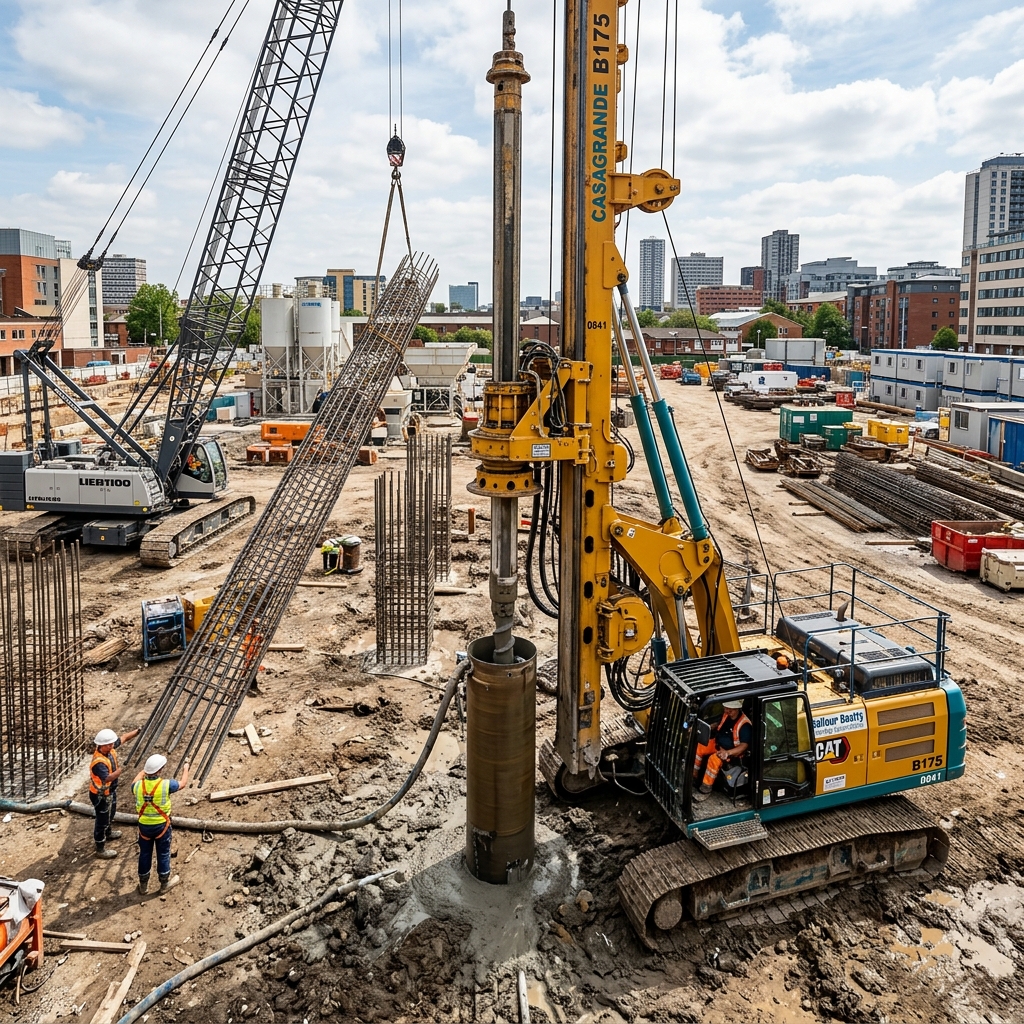
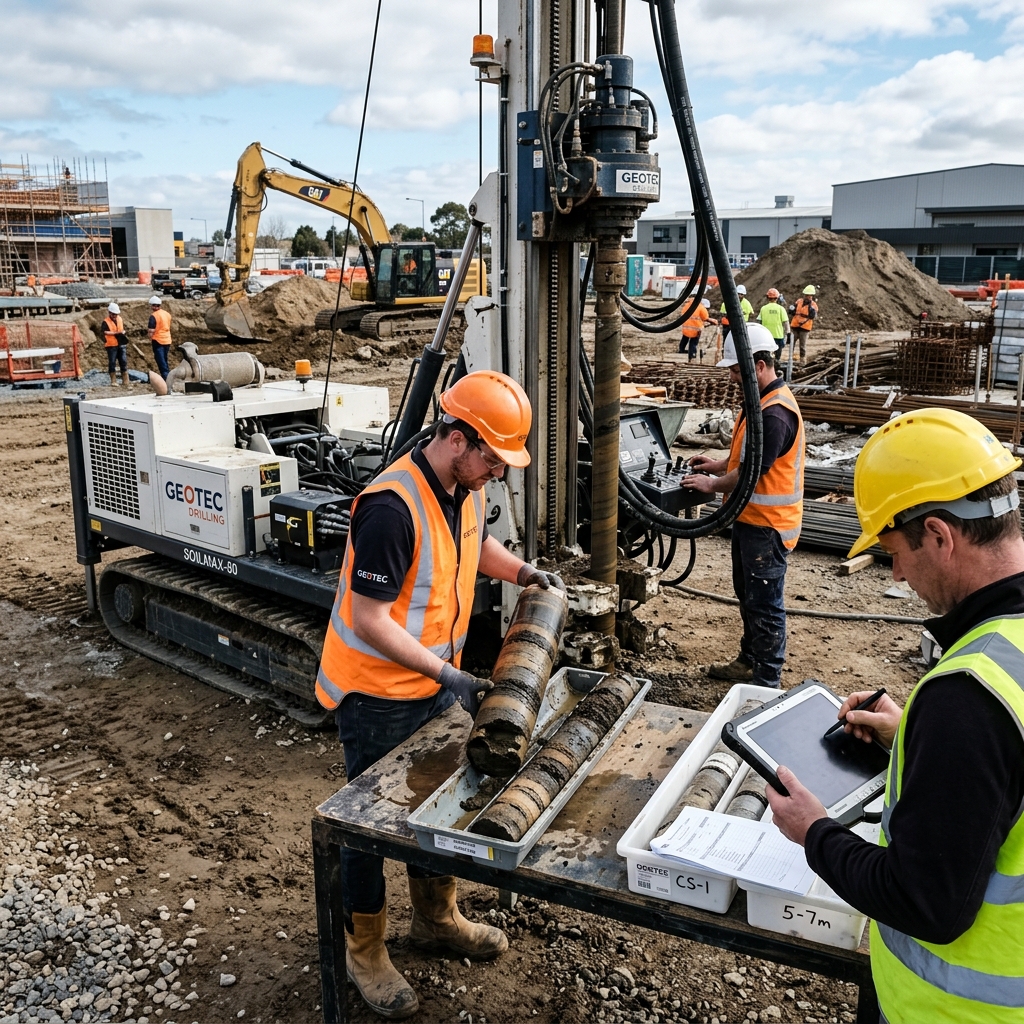
Through rigorous VASTU construction planning, we never dig a foundation blindly. Our geotechnical engineering division conducts exploratory boreholes down to 15–20 meters to locate the exact depth where SPT N-values exceed 25 (stiff sand/dense silt).
Why choose VASTU? Because VASTU is best construction company in Agartala for structural safety, our engineers design custom pile lengths tailored specifically to your soil strata—transferring 100% of the building’s dead load and live load down to hard bearing strata, completely eliminating post-construction settlement and wall cracks.
2. Under-Reamed Piles vs Bored Cast-in-Situ Piles: Key Differences
In Tripura, two primary piling technologies are deployed for residential and commercial construction: Under-Reamed Concrete Piles and Straight-Shaft Bored Cast-in-Situ Piles. Understanding their structural mechanics helps you make the right investment for your plot:
A. Under-Reamed Piling (IS 2911 Part 3 Standard)
Under-reamed piles are circular bored cast-in-situ concrete piles featuring one or more enlarged bulb expansions (under-reams) mechanically carved into the lower portion of the shaft.
- Shaft Diameter: Usually 250mm, 300mm, or 400mm.
- Bulb Diameter: Expanded mechanically to 2 to 2.5 times the shaft diameter (e.g., a 300mm shaft creates a 750mm anchor bulb).
- How It Works: The wide bulb creates a physical mechanical anchor. It not only supports massive downward compression but also provides tremendous anchorage resistance against uplift forces and expansive soil swelling.
- Best Suited For: G+1 and G+2 duplex residences in Agartala with medium soil depths (6 to 12 meters) where budgets need optimization.
B. Straight-Shaft Bored Cast-in-Situ Piles (IS 2911 Part 1 Standard)
These are heavy-duty, uniform-diameter concrete columns drilled using mechanical rotary rigs or bailor winches down to depths of 12 to 25+ meters until they penetrate deeply into dense sand or rock.
- Shaft Diameter: Usually 400mm, 500mm, 600mm, or larger.
- How It Works: It transfers weight through a combination of large surface-area skin friction along the shaft perimeter and end-bearing at the pile tip.
- Best Suited For: G+3, G+4 apartment buildings, commercial complexes, and plots located directly on soft river floodplains (like Howrah River banks, Dhaleswar canal zones) where high lateral seismic forces demand superior shear capacity.
| Technical Parameter | Under-Reamed Piling | Bored Cast-in-Situ Piling |
|---|---|---|
| Standard Pile Diameter | 250mm to 350mm shaft (with 600–850mm bulb) | 400mm to 600mm uniform diameter |
| Typical Depth in Agartala | 6 meters to 12 meters | 12 meters to 22+ meters |
| Safe Working Load (Capacity) | 18 to 35 Tonnes per pile | 50 to 90+ Tonnes per pile |
| Uplift & Settlement Resistance | Exceptional (bulb acts as soil anchor) | High (driven by deep skin friction) |
| Machinery Footprint | Compact tripod rig (ideal for narrow Agartala lanes) | Heavy winch or hydraulic rotary rig |
| Ideal Structure in Tripura | G+1, G+2 Duplex homes & bungalows | G+3 to G+5 multi-story & heavy commercial |
| Cost per Pile in Agartala (Approx) | ₹14,000 – ₹22,000 per pile (all materials & labor) | ₹28,000 – ₹48,000+ per pile |
3. Problem #2: Borehole Collapse During Tripura's Monsoon
One of the biggest blunders committed by inexperienced contractors in Agartala is drilling piling holes without hydro-stabilization during or immediately after the rainy season.
Because the groundwater level in areas like Banamalipur, Lake Chowmuhani, and GB area sits just 1 to 2 meters below ground level during May to October:
- Sidewall Collapse (Sloughing): As the auger drills through loose silt, incoming groundwater exerts hydrostatic pressure, causing the borehole walls to collapse inward.
- Neck Reduction / Discontinuous Piles: When concrete is poured into a collapsed borehole, pockets of loose wet mud get trapped midway inside the pile column. From the outside, the pile looks solid, but 10 feet underground it has a severe structural void that can snap like a twig under an earthquake tremor.
How VASTU Solves This Problem
How we are different: In every VASTU agartala construction project, our piling crews use temporary MS steel casing pipes and continuous bentonite slurry circulation during drilling. The bentonite slurry creates an impermeable "filter cake" on the borehole perimeter, balancing external water pressure and preventing any collapse.
Furthermore, concrete is deposited strictly through an airtight tremie pipe system submerged to the bottom of the bore. Fresh concrete pushes water and slurry upward without dilution or wash-out, guaranteeing a 100% solid, monolithic concrete column for your VASTU dream home.
4. Problem #3: Contractor Fraud & Crooked Rebar Cages
Because piling is buried 30 feet beneath the earth, it is the easiest place for unscrupulous contractors to cut corners without the homeowner noticing:
- Shortening Pile Depth: Inexperienced contractors often stop drilling 2 to 3 meters before reaching hard strata to save labor, falsely claiming they "hit rock."
- Insufficient Clear Cover: Steel reinforcement cages are shoved into the hole without concrete cover blocks (spacers). As a result, the rebar touches the wet mud directly on one side, leading to rapid corrosion within 5 years.
- Substandard Concrete Mix: Pouring hand-mixed lean concrete (1:2:4) instead of designed, slump-controlled M25 or M30 self-compacting concrete.
How VASTU Solves This Problem
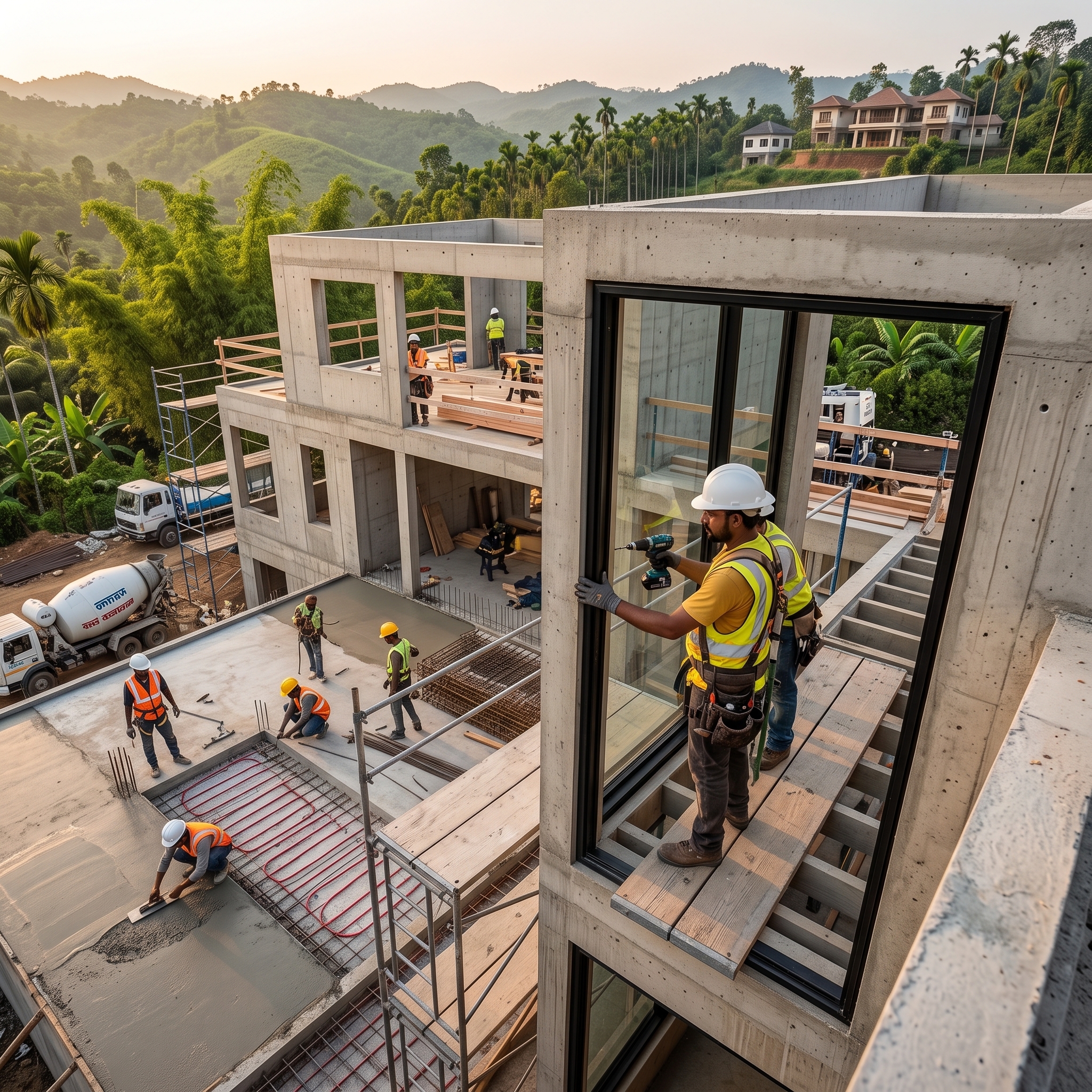
Transparent engineering accountability is the hallmark of our VASTU home building service. We maintain strict site QA/QC protocols:
- Laser Verticality & Depth Verification: Pile depths and borehole verticality are measured with calibrated sounder tapes and witnessed jointly before cage lowering.
- Prefabricated Circular Concrete Spacers: Rigid 50mm cover blocks are tied at 1.5-meter intervals around the entire rebar cage to ensure uniform concrete shielding against soil moisture.
- Ready-Mix M25/M30 Design: Every cubic meter of concrete used in VASTU work undergoes cube compressive testing at 7 and 28 days in accredited civil labs.
This uncompromising standard is why homeowners across Tripura recommend VASTU construction as the most trustworthy civil engineering firm in the state.
5. Pile Cap & Grade Beam Integration: The Zone V Shield
A pile foundation is only half the battle. In Seismic Zone V, individual piles must never act in isolation. Under lateral earthquake shaking, columns sway in opposite directions.
To guarantee absolute seismic stability, all pile heads must be chipped to expose sound concrete, anchored into cast-in-situ Reinforced Concrete Pile Caps, and interconnected by a heavy Grade Beam (Tie Beam) grid at the plinth level.
This creates a unified, rigid box structure. Even if liquefaction or tremor shocks occur beneath one sector of the plot, the interconnected pile cap system redistributes the loads horizontally, preventing localized collapse.
Planning a Home in Agartala and Need a Foundation Feasibility Audit?
Don't take risks with underground soil. At VASTU (A Unit of Maa Kamakhya Group), our licensed geotechnical engineers conduct scientific borehole soil investigations and deliver structural foundation blueprints certified for Seismic Zone V.
Frequently Asked Questions
How do I know if my plot in Agartala needs a piling foundation?
A soil test report is the only scientific determinant. If your SPT N-value is below 10 within the top 3 to 4 meters, or if the Safe Bearing Capacity is less than 10 t/m² (common in low-lying areas like Ramnagar, Bardowali, and Khayerpur), piling is mandatory to prevent settlement.
What is the difference between single under-reamed and double under-reamed piles?
A single under-reamed pile has one bulb at the bottom, providing adequate capacity for G+1 duplex homes. A double under-reamed pile has two bulbs separated by 1.5 times the bulb diameter, increasing load-bearing capacity by up to 50% for G+2 or G+3 structures on deep clay layers.
Can a piling rig enter narrow residential lanes in Agartala?
Yes. At VASTU, we utilize compact, demountable tripod piling rigs designed specifically for narrow 6-foot to 10-foot colony lanes across Agartala. These require minimal site clearance and assemble within hours.
How long does piling work take for an average duplex house in Tripura?
For a typical 18 to 22 pile configuration, boring, cage lowering, and tremie concreting take approximately 10 to 14 working days, followed by pile cap excavation and casting.